
Spinal cord injury Treatment In Hanumangarh
A spinal cord injury, which involves damage to any part of the spinal cord or nerves at the spinal canal’s end, often leads to permanent changes in strength, sensation, and other body functions below the injury site.
Experiencing a spinal cord injury may seem overwhelming, as it can affect various aspects of your life. Despite the challenges, ongoing research offers hope for future treatments to repair spinal cord injuries. Meanwhile, current treatments and rehabilitation enable many individuals with spinal cord injuries to maintain productive, independent lives.
Symptoms:
The extent of your ability to control your limbs after a spinal cord injury depends on the injury’s location along your spinal cord and its severity. The neurological level of the injury refers to the lowest part of your spinal cord that functions normally post-injury. The severity, known as “completeness,” falls into two categories:
- Complete: If almost all sensory and motor functions below the injury site are lost, it is considered a complete injury.
- Incomplete: If there is some motor or sensory function below the affected area, it is termed incomplete, with varying degrees of severity.
Paralysis resulting from a spinal cord injury may be classified as:
- Tetraplegia (Quadriplegia): Affecting your arms, hands, trunk, legs, and pelvic organs.
- Paraplegia: Paralysis impacting all or part of the trunk, legs, and pelvic organs.
A series of tests conducted by your healthcare team will determine the neurological level and completeness of your injury.
Spinal cord injuries can lead to several signs and symptoms, including:
- Loss of movement
- Loss of sensation, including heat, cold, and touch
- Loss of bowel or bladder control
- Exaggerated reflex activities or spasms
- Changes in sexual function, sensitivity, and fertility
- Pain or intense stinging sensation due to nerve fiber damage in the spinal cord
- Difficulty breathing, coughing, or clearing lung secretions
Emergency Signs and Symptoms: Following an accident, emergency signs and symptoms of a spinal cord injury may include:
- Extreme back pain or pressure in the neck, head, or back
- Weakness, incoordination, or paralysis in any body part
- Numbness, tingling, or loss of sensation in hands, fingers, feet, or toes
- Loss of bladder or bowel control
- Difficulty balancing and walking
- Impaired breathing after injury
- Unusual neck or back position
When to Seek Medical Attention: If someone experiences significant head or neck trauma, immediate medical evaluation for possible spinal injury is essential. It is safest to assume trauma victims have a spinal injury until proven otherwise because:
- Serious spinal injuries are not always immediately obvious, and delayed recognition could lead to more severe damage.
- Numbness or paralysis may develop gradually due to bleeding or swelling around the spinal cord.
- Prompt treatment is crucial in minimizing complications and enhancing recovery.
If you suspect a back or neck injury:
- Do not move the injured person: Moving them could lead to permanent paralysis and serious complications.
- Call 911 or local emergency services: Seek immediate medical assistance.
- Keep the person still: Prevent any movement of the head and neck.
- Provide basic first aid: Stop bleeding and make the person comfortable without moving their head or neck. Use heavy towels on both sides of the neck or hold the head and neck to prevent movement until emergency care arrives.
Causes:
Spinal cord injuries occur due to damage to the vertebrae, ligaments, disks of the spinal column, or the spinal cord itself.
Traumatic spinal cord injuries can result from a sudden, forceful impact on the spine, causing fractures, dislocations, crushes, or compression of one or more vertebrae. They can also be caused by gunshot or knife wounds that penetrate and cut the spinal cord. Additional damage often occurs over days or weeks due to bleeding, swelling, inflammation, and fluid accumulation around the spinal cord.
Nontraumatic spinal cord injuries may be caused by conditions like arthritis, cancer, inflammation, infections, or degeneration of spinal disks.
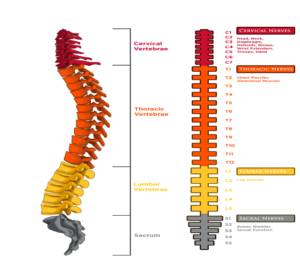
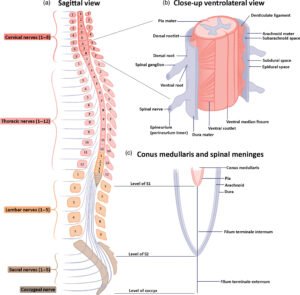
Your Brain and Central Nervous System The central nervous system includes the brain and spinal cord. The spinal cord, composed of soft tissue and surrounded by vertebrae, extends from the base of the brain and consists of nerve cells and groups of nerves called tracts, which connect to various parts of the body.
The spinal cord terminates just above the waist in a region called the conus medullaris, below which lies a cluster of nerve roots known as the cauda equina.
Nerve tracts within the spinal cord convey messages between the brain and the rest of the body. Motor tracts transmit signals from the brain to control muscle movement, while sensory tracts relay signals from body parts to the brain, including sensations of heat, cold, pressure, pain, and limb position.
Damage to Nerve Fibers Regardless of the cause, spinal cord injuries impact nerve fibers passing through the injured area, potentially impairing some or all muscles and nerves below the injury site.
Injuries to the chest (thoracic) or lower back (lumbar) can affect the torso, legs, bowel and bladder control, and sexual function. A neck (cervical) injury can affect arm movements and may also impact breathing.
Common Causes of Spinal Cord Injuries The primary causes of spinal cord injuries in the United States are:
- Motor vehicle accidents: Auto and motorcycle accidents are the leading cause, contributing to over 35 percent of new spinal cord injuries annually.
- Falls: Falls are the predominant cause of spinal cord injuries in individuals over 65, accounting for more than 25 percent of cases overall.
- Acts of violence: Approximately 15 percent of spinal cord injuries result from violent encounters, often involving gunshot or knife wounds.
- Sports and recreation injuries: Athletic activities, especially impact sports and diving in shallow water, contribute to around 9 percent of spinal cord injuries.
- Alcohol: Alcohol use is a factor in about 25 percent of spinal cord injuries.
- Diseases: Conditions such as cancer, arthritis, osteoporosis, and inflammation of the spinal cord can lead to spinal cord injuries.
Physiotherapy Treatment
Although spinal cord injuries can occur due to accidents and affect anyone, certain factors may increase the risk:
- Being male: Men are disproportionately affected, with females accounting for only about 20 percent of traumatic spinal cord injuries in the United States.
- Age between 16 and 30: The highest risk of traumatic spinal cord injury occurs among individuals aged 16 to 30.
- Age over 65: Falls are the primary cause of injuries in older adults.
- Engaging in risky behavior: Activities like diving into shallow water or playing sports without proper safety gear can lead to spinal cord injuries, with motor vehicle crashes being the leading cause for individuals under 65.
- Bone or joint disorders: Conditions such as arthritis or osteoporosis can increase the risk of spinal cord injury, even from minor incidents.
If you’re searching for expert Spinal cord injury treatment in Hanumangarh, trust us for personalized care and effective rehabilitation. Regain confidence in your movements and resume your normal activities swiftly with our specialized Spinal cord injury treatments. Visit Dr. Ram Sihag physiotherapy Clinic today for Spinal cord injury care tailored to your needs.
Copyright ©2023 all rights reserved